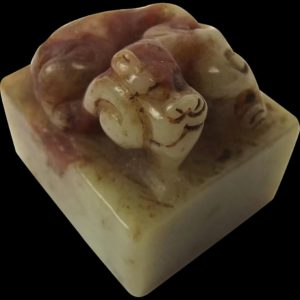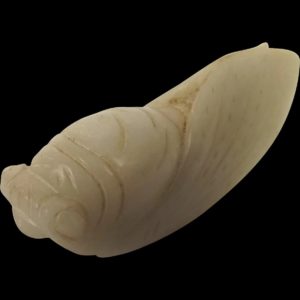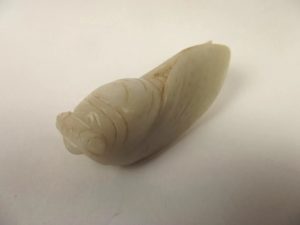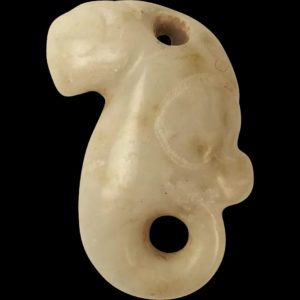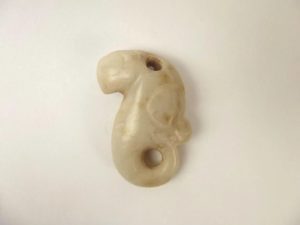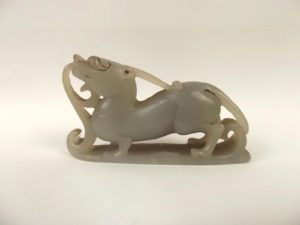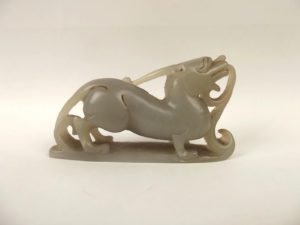


~ Chinese Nephrite Jade Carving of a Recumbent Elephant in Archaistic Wei Style, Qing Dynasty, 18th to 19th Century ~
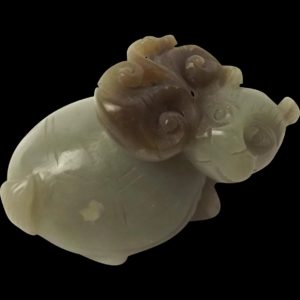
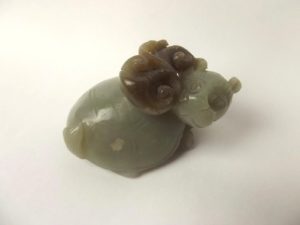
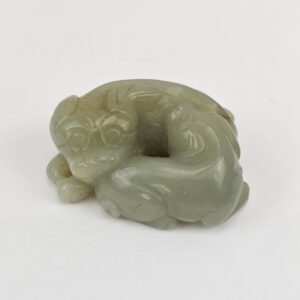
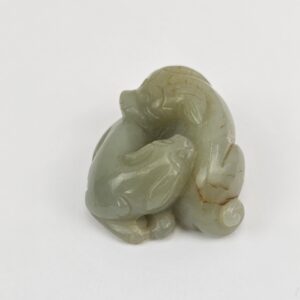
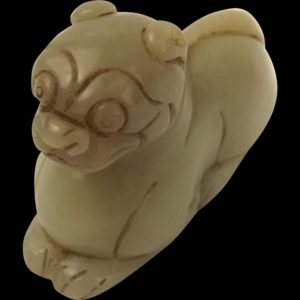
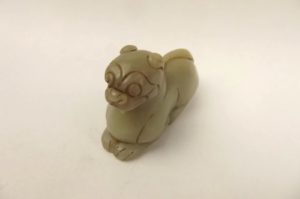
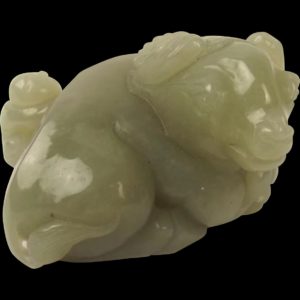
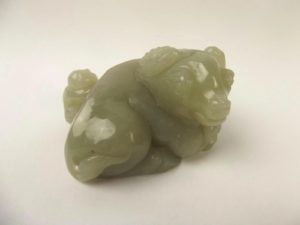
A hand-carved nephrite jade figure of a recumbent elephant worked in an archaistic style referencing the bold, stylised aesthetic of the Northern Wei period, the whole conceived from a compact pebble-like form giving the piece a satisfying weight and solidity in the hand. The elephant is shown at rest, its body forming a smooth, high-domed oval mass when seen from above or to the side, with the four legs folded beneath and visible as rounded, lobe-like elements when viewed from the underside. The trunk curves forward and upward from the broad, rounded head, terminating with two clearly defined circular nostrils, and is shown slightly raised as if scenting the air. The large ears are rendered as broad, flat, fan-shaped projections to either side of the head, their edges delineated by incised curved lines suggesting the natural folds and ridges of elephant ear anatomy in a stylised manner. The eyes are simplified, with a small circular carved form to each side of the head. The body carries incised decoration in the archaistic mode, with bold curvilinear incisions suggesting musculature, a stylised saddle or decorative caparison cloth across the back, and leaf and scroll motifs worked into the transitional areas between the head and body. The underside shows the four legs as rounded, separated rounded masses with incised detail, and further scrollwork linking the leg forms. The stone is a warm celadon to olive-grey nephrite throughout, with amber-brown veining and inclusions running through the body in sweeping natural lines, concentrated particularly in the ear areas and lower body where they create a warm tonal contrast with the paler celadon zones of the upper body. The surface carries a fine, well-established satin polish.
Historical Context
The Northern Wei Dynasty (386 to 534 AD) produced some of the most striking and influential sculptural art in Chinese history, characterised by bold, linear stylisation, simplified volumes and a powerful graphic quality that distinguished it from both the naturalism of later periods and the formal restraint of the preceding Han Dynasty. Wei period stone and jade carvings of animals typically feature these qualities in condensed form, rendering familiar subjects in a deliberately abstracted idiom that prioritises decorative energy over anatomical precision.
The archaistic tradition in Chinese jade carving reached its fullest expression during the Ming and Qing dynasties, when scholar-collectors and court workshops alike produced pieces consciously imitating the forms and decorative vocabularies of earlier periods, including the Zhou, Han, and Wei periods. Such archaistic pieces were deeply valued within Chinese connoisseurship, prized not merely as imitations but as sophisticated dialogues with the past, demonstrating the carver's and patron's knowledge of classical forms. An archaistic elephant in Wei style would have occupied a prestigious position in the scholar's studio or the collection of a man of learning, associating its owner with the deep antiquity of Chinese civilisation.
The elephant in Chinese art carries multi-layered auspicious significance. The Chinese word for elephant, xiàng, is a homophone of the word for auspiciousness and for a high official's rank, making the elephant a powerful talisman of good fortune, official success and prosperity. The raised trunk is a further auspicious gesture, associated with drawing in blessings and good luck. Recumbent elephant carvings in jade were among the most desirable animal subject pieces throughout the Qing period, and the added dimension of archaistic styling here gave such pieces scholarly prestige in addition to their general auspicious resonance.
~ Dimensions ~
The elephant has a length of 2.2 inches (5.6 cm), a width of by 1 inches (2.2 cm) and a height of 1.25 inches (3.1 cm).
It weighs 72g.
~ Condition ~
The piece is in great condition with no cracks or chips.
#1371