*British, 1937, Bank of England Ten Pounds White Note, Peppiatt Signature, K185 36424, Possible Operation Bernhard Forgery*
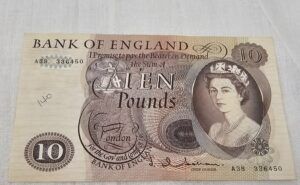
An original Bank of England Ten Pounds (£10) “White Note”, dated 17 March 1937, issued in London and signed by H. O. Peppiatt, Chief Cashier of the Bank of England. The note measures 21.3 × 13.1 cm and retains the classic large-format black-and-white engraved design, featuring the seated Britannia vignette at upper left with ornate surrounding scrollwork and calligraphic text.
When held to a light this note displays the correct large repeating TEN / POUNDS watermark pattern, clearly visible, well aligned, and showing good tonal depth. Serial number K185 36424. A small edge punch to the right margin is present, together with three small historic pinhole marks located just outside the Britannia medallion, visible on close inspection.
This note falls within a serial and date range discussed in specialist literature in relation to Operation Bernhard, and while it displays many characteristics of genuine Bank of England manufacture, it cannot be definitively excluded as a high-quality German wartime forgery.
Historical & Attribution Note – Operation Bernhard:
During the Second World War, Nazi Germany undertook a large-scale counterfeiting programme known as Operation Bernhard (1942–1945), overseen by SS-Sturmbannführer Bernhard Krüger and carried out at Sachsenhausen concentration camp. Approximately 150 forced specialist prisoners — many of them Jewish engravers, printers and graphic technicians — were compelled to produce counterfeit Bank of England white notes using copied designs and stolen materials. The original intention was to destabilise the British economy by flooding the United Kingdom with forged currency, though this plan was later abandoned in favour of using the notes to purchase goods in neutral countries and to fund espionage activities. One of the best-known recipients was the German agent Elyesa Bazna, codenamed Cicero. Toward the end of the war, large quantities of counterfeit notes were disposed of in Lake Toplitzsee and nearby Alpine waterways, from which some examples have since been recovered.
The Bernhard notes were deliberately back-dated, most commonly to the 1930–1938 period, and frequently bore convincing reproductions of genuine Chief Cashier signatures, including that of H. O. Peppiatt. Research by Pam West and other specialist literature has demonstrated that the counterfeiters copied genuine prefixes, but did not reproduce entire prefix ranges, instead working in limited and often discontinuous serial clusters. As a result, there is a documented numerical overlap between genuine Bank of England notes and Bernhard forgeries, meaning that serial number and date alone are insufficient for definitive attribution.
The present note falls within a serial and date region discussed in Bernhard literature, specifically within the K185/36 prefix range referenced by Pam West as potentially associated with Bernhard production. Physical examination shows convincing paper translucency, a strong and correctly formed watermark, sharp intaglio printing, and natural circulation wear, all characteristics consistent with genuine Bank of England manufacture. At the same time, the presence of historic pinholes, together with minor printing irregularities such as ink blobs and variation within the beaded ornament, are features known to occur on both genuine notes and on the highest-quality Bernhard forgeries, as Sachsenhausen printers were instructed to introduce signs of wear to disguise their work.
Given the deliberate sophistication of the Operation Bernhard programme and the known numerical overlap between genuine and forged issues, it is not possible to state definitively that this example is not a German wartime forgery without third-party forensic certification. This uncertainty is intrinsic to the note and forms part of its appeal, making it an exciting acquisition: either a genuine pre-war Bank of England £10 white note, or a rare and exceptionally convincing wartime Operation Bernhard forgery. The note is therefore best described as likely genuine, while transparently acknowledged as potentially a German wartime forgery.
Pinholes, Wear & Historical Context:
For more than a century, higher-denomination banknotes were routinely pinned to documents, ledgers, and vouchers in banks and offices. As a result, pinhole marks are commonly encountered on pre-war Bank of England white notes, particularly £10 issues that saw institutional rather than personal circulation.
It is also documented that prisoners involved in Operation Bernhard were instructed to add signs of wear, including pinholes, folds, and small cuts, to make forged notes appear circulated. Some accounts suggest that individual prisoners attempted to place pinholes in or near the Britannia medallion, believing that no British clerk would willingly pierce a national emblem. This practice was not systematic, and such pinholes are not conclusive in isolation, but their presence and location form part of the wider assessment.
On this note, three small pinholes are visible just outside the Britannia medallion, consistent with either historic banking handling or deliberate ageing, and are considered alongside all other physical characteristics.
Printing Detail Note:
The beaded ornament around the word TEN shows minor variation, with some beads appearing flattened or partially open. Pam West notes that on genuine notes the beads are engraved as complete circles, while malformed or halved beads can be a feature of some Operation Bernhard forgeries. The characteristics seen here are therefore not definitive and may be consistent with either a genuine pre-war Bank of England issue or a high-quality wartime forgery.
*Condition*
The note displays honest circulation wear and age toning, with soft handling creases. Three small historic pinholes are present near the Britannia medallion, along with a small edge punch to the right margin. No repairs, reinforcement, or annulment stamps (such as ANNULE, FORGED, FALSIFICATION or FAUX) are evident. Printing remains strong and legible throughout, with a clear Britannia vignette and well-defined watermark. Overall condition is consistent with a Fine to Good Very Fine circulated example. Please see photographs as part of the condition report.
RQMAEOXCHO_9745223165