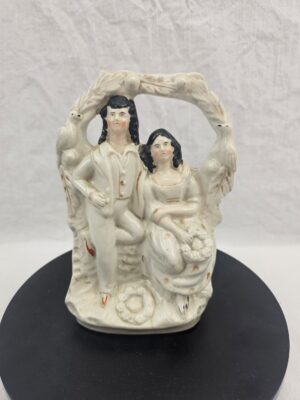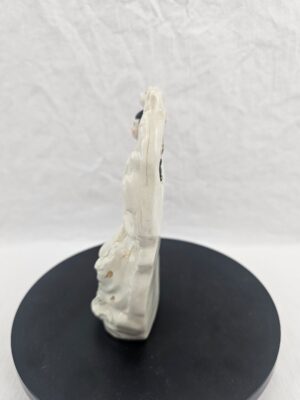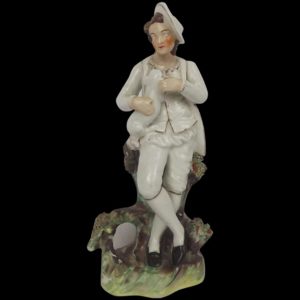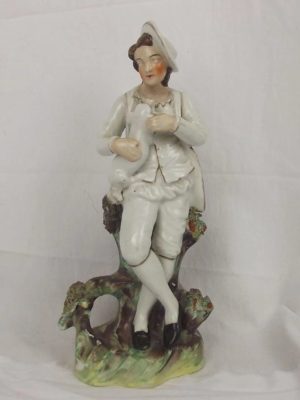
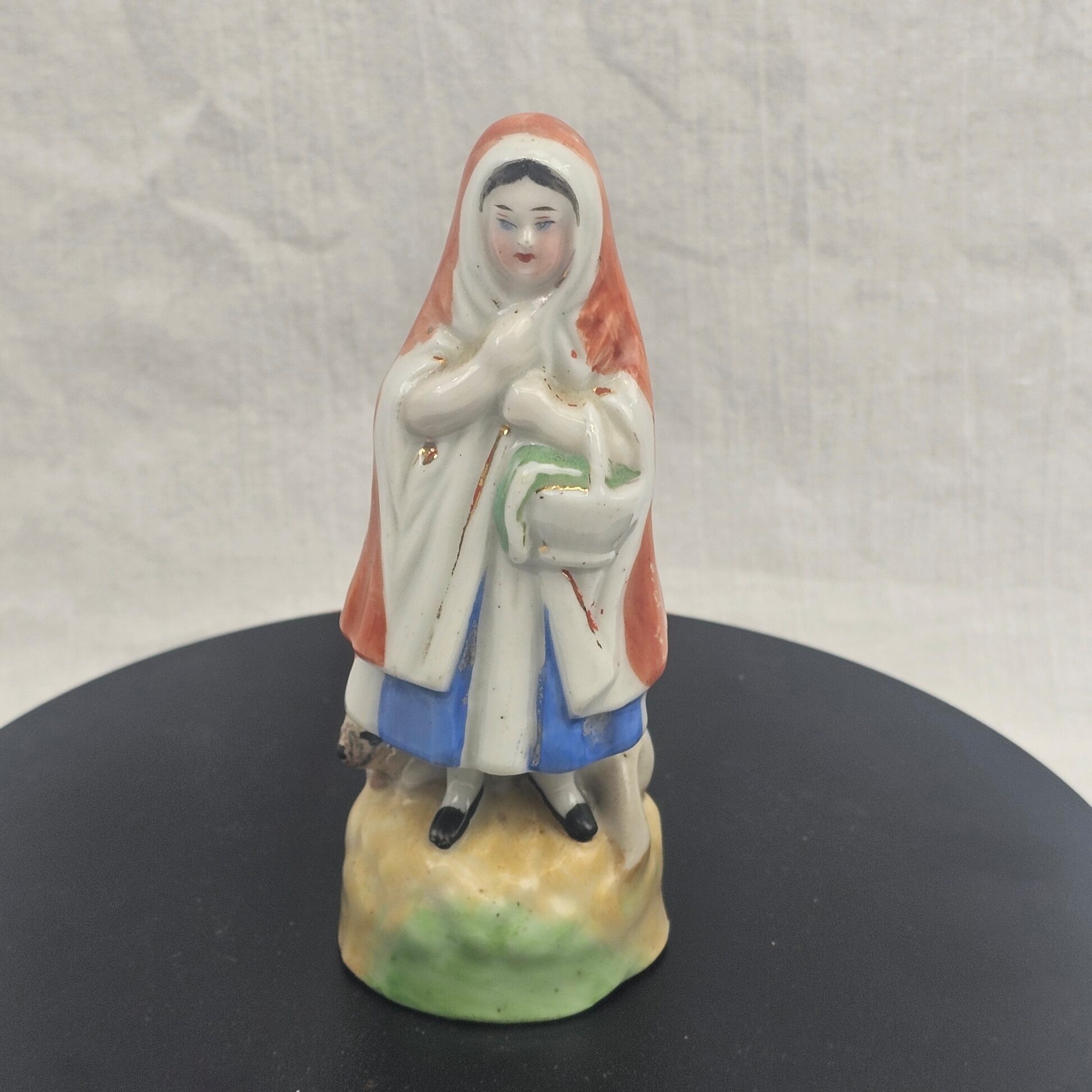
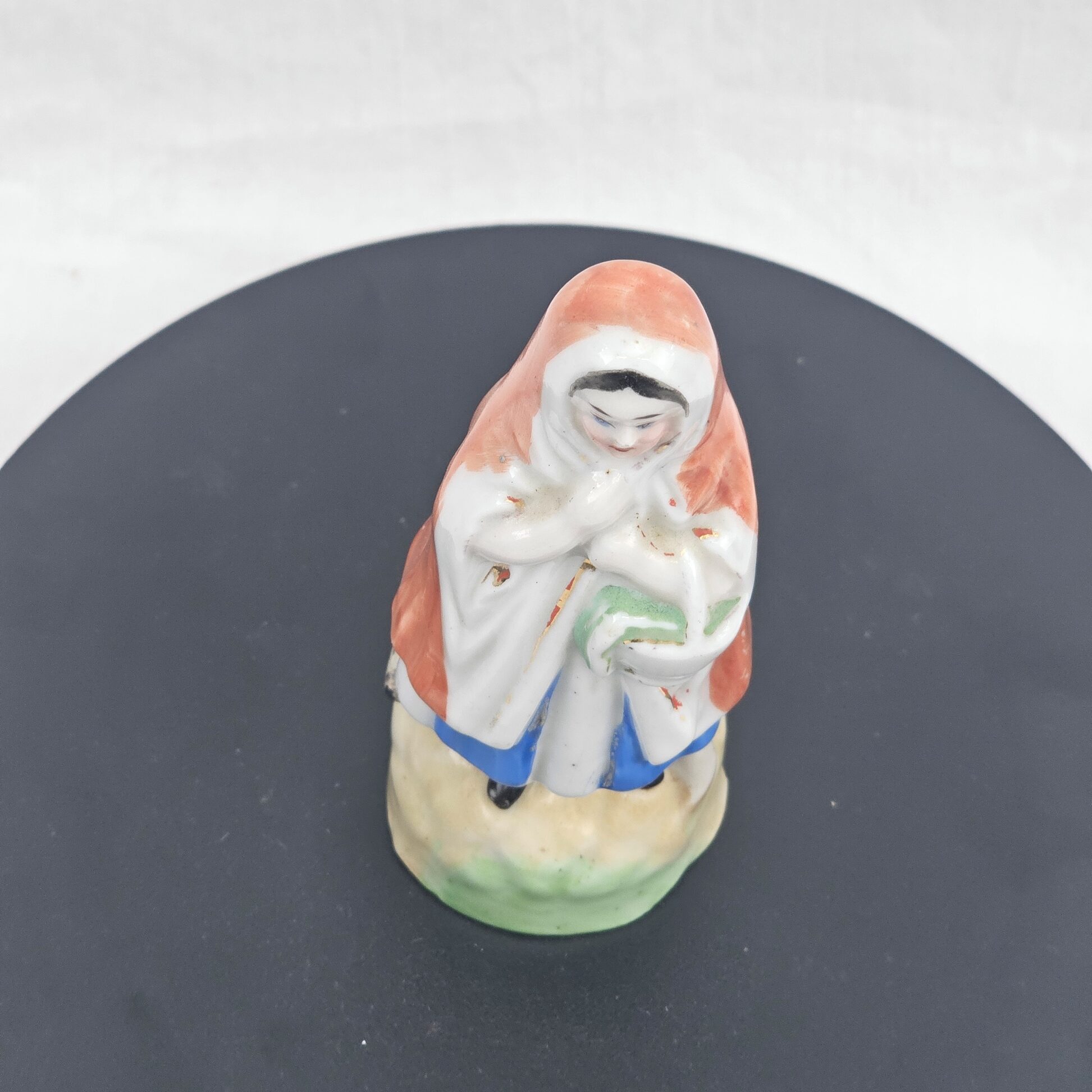
~ Victorian Staffordshire Pottery Figure of a Shepherdess (Bo Peep Type), circa 1850–1870 ~
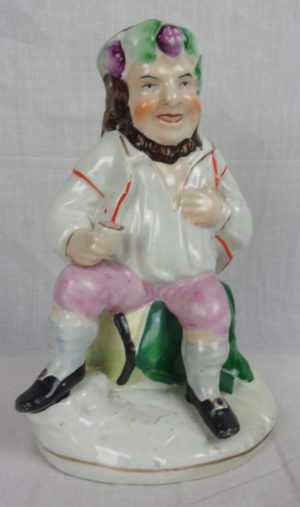
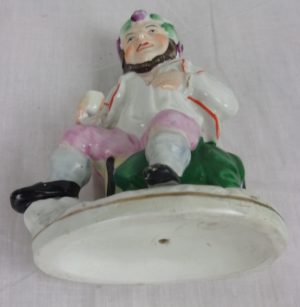
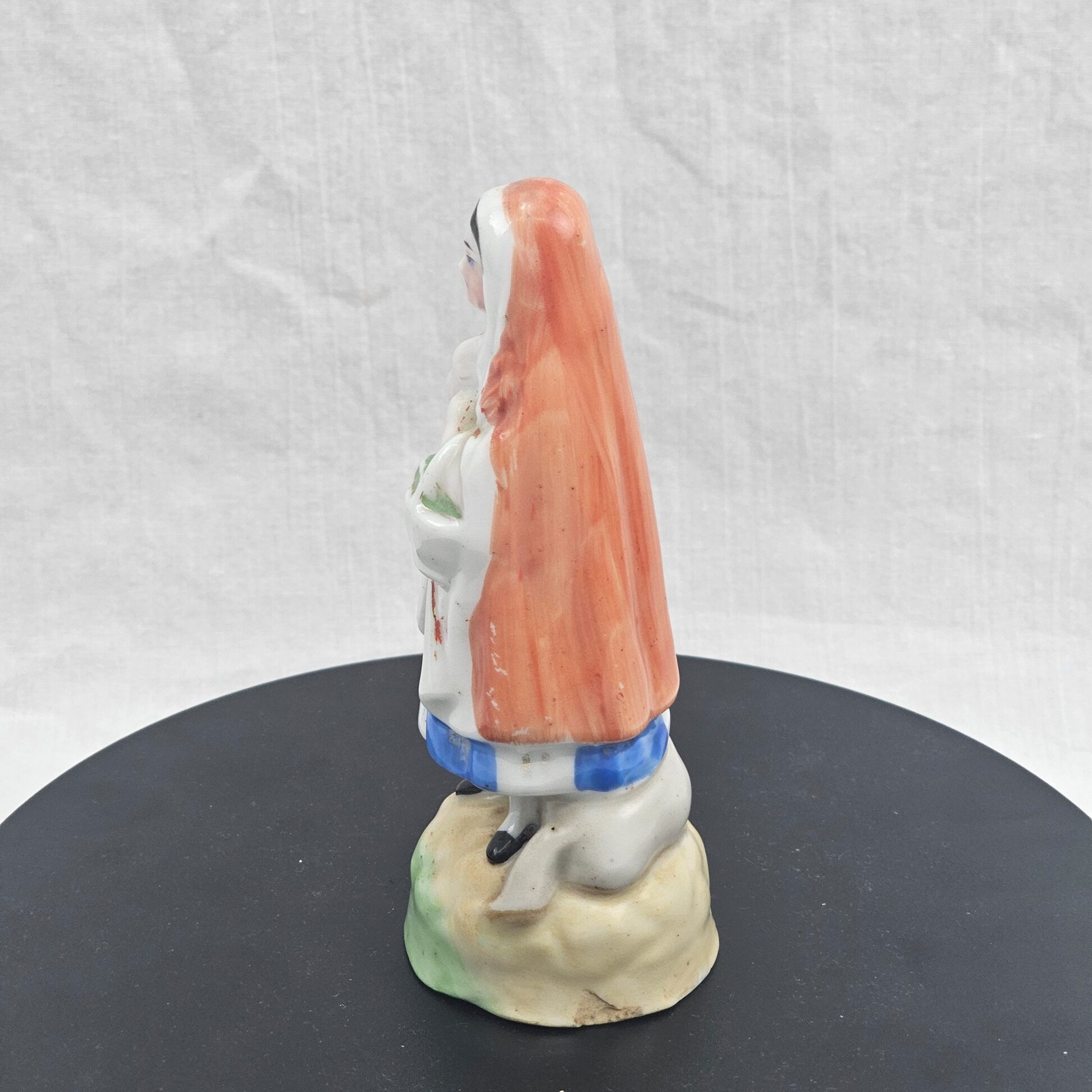
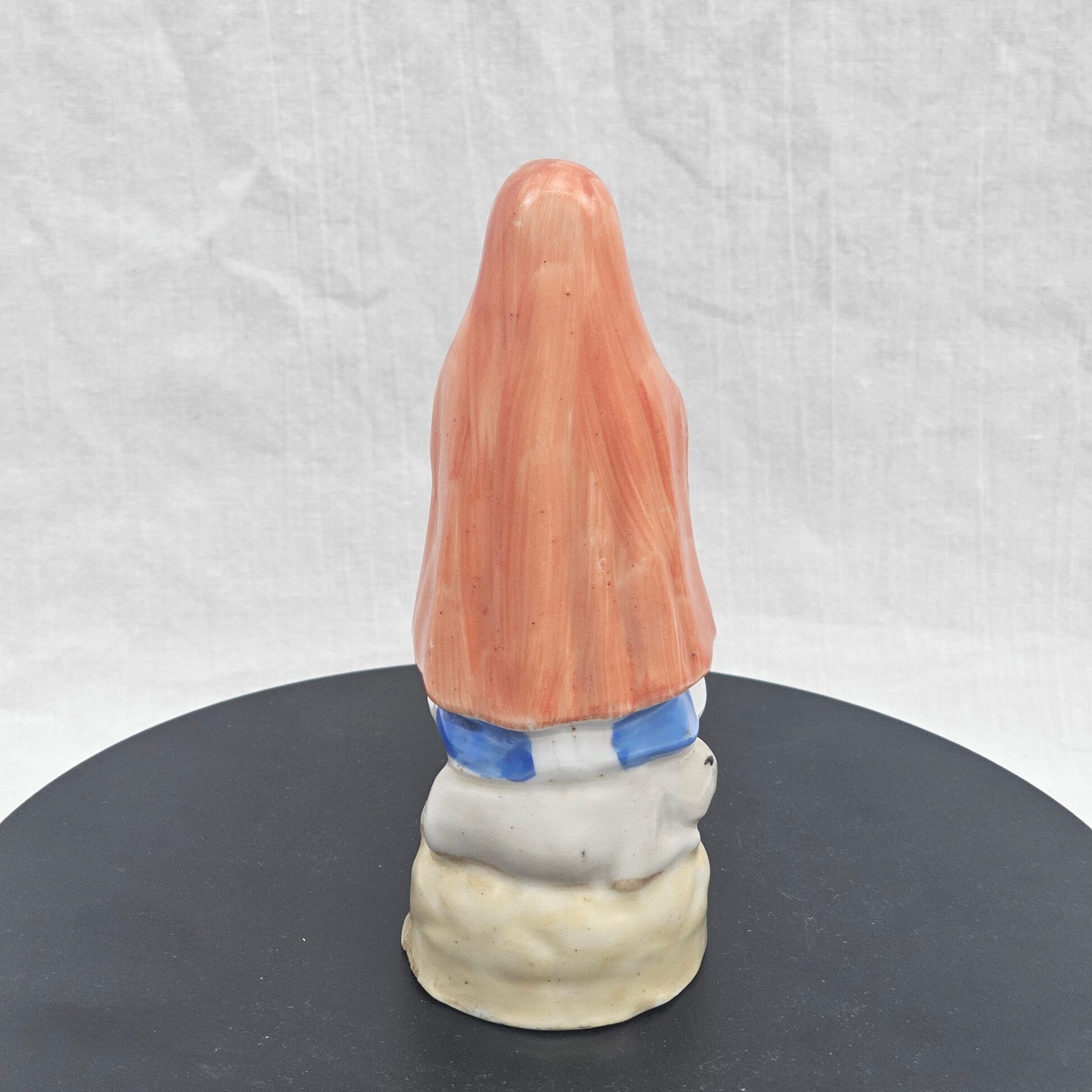
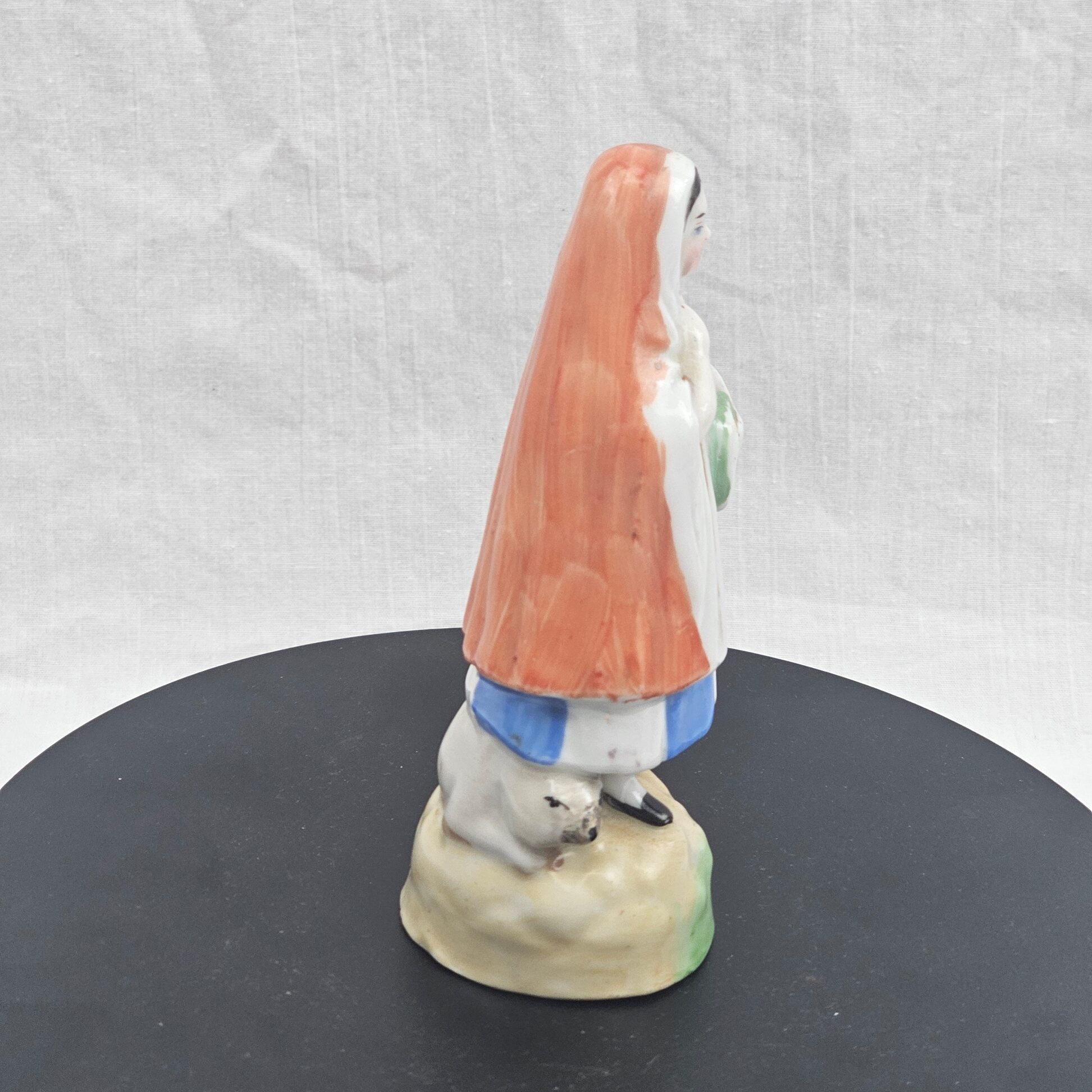
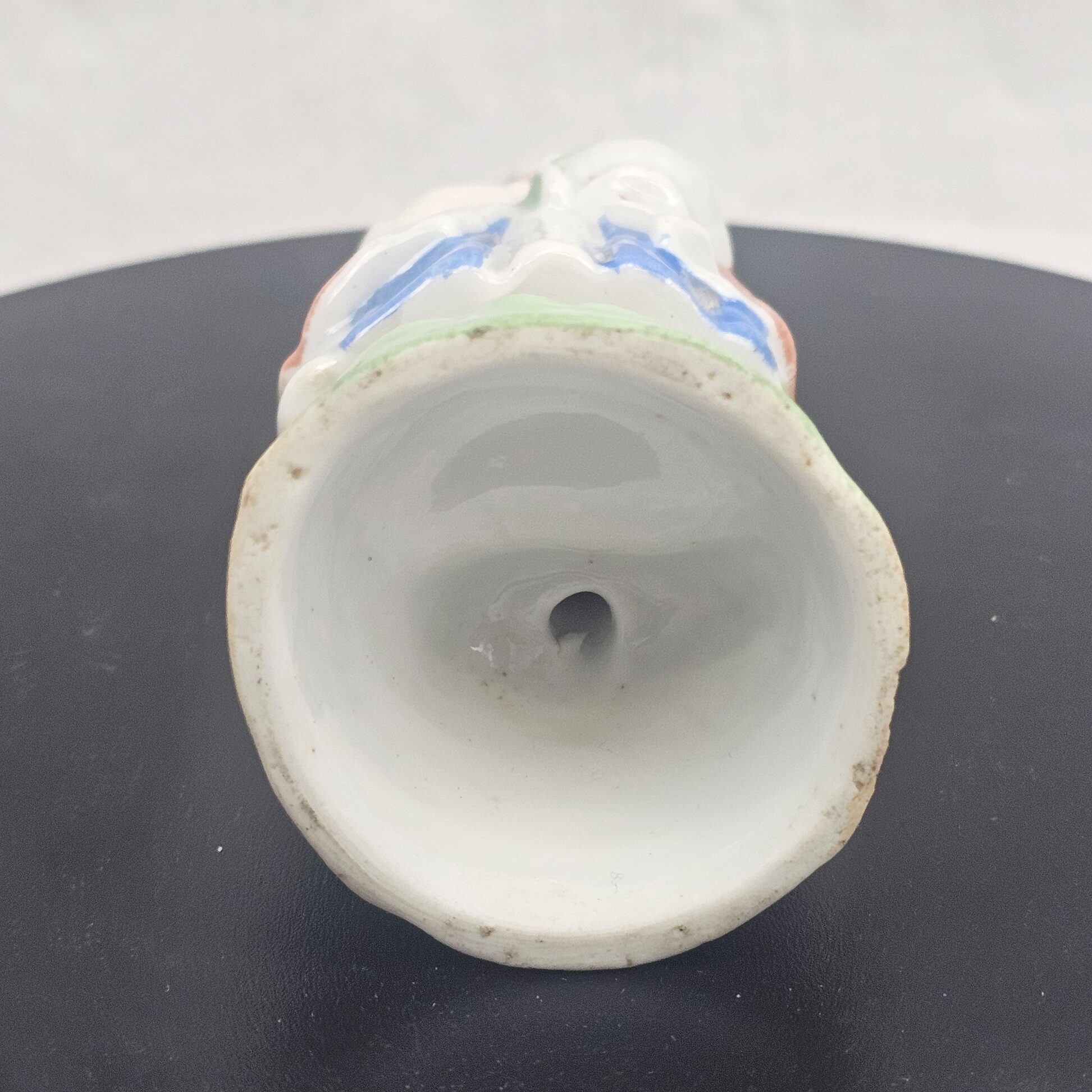
A charming and hand-painted Victorian Staffordshire earthenware figure of a standing shepherdess, modelled in the popular "Little Bo Peep" tradition and typical of the smaller decorative output of the mid-to-late Victorian Staffordshire potteries. The figure depicts a young woman in a white head-covering framed by a boldly painted orange-red hooded cloak or mantle, with a blue dress visible below. She holds a small lamb or sheep tightly against her chest, with traces of green detail to the swaddling or wrapping. A small recumbent sheep or dog accompanies her at her feet to one side. Her face is delicately painted with blue eyes, dark brows, black hair and a small red mouth, with a characteristically demure expression. The figure stands on an irregular naturalistic mound base, painted in yellow, cream and green to suggest grass and earth. Touches of gilding are present to the front of the figure. The reverse, as is typical of flatback production of this period, is undecorated — the orange cloak flows smoothly to the back without secondary modelling. The base is hollow and open underneath, with a small central vent hole, consistent with press-moulded earthenware construction.
~ Historical Context ~
Victorian Staffordshire figures were made between 1837 and 1900, typically decorated with coloured enamels over a plain lead glaze. Inexpensive and widely popular, they were images in clay of the people, by the people — idealised scenes of pastoral life, sentiment, and popular culture at a time when most ordinary folk could not access fine art. Shepherdess figures were among the most consistently produced subjects throughout the Victorian period, drawing both on the pastoral tradition in European decorative arts and on the enduring nursery rhyme character of "Little Bo Peep," whose image — a young girl in a hooded cape seeking her lost sheep — had been firmly embedded in popular culture since the 1810s. Figures depicting pastoral scenes and pursuits were of great sentimental importance to the rural poor now flocking to find work in rapidly industrialising towns and villages, making the shepherdess one of the most commercially reliable of all Staffordshire subjects throughout the era. This example, with its flatback construction, enamel overglaze palette, and mound base, is consistent with production from the 1850s–1870s. As with the overwhelming majority of figures from this period, it bears no maker's mark.
~ Condition Report ~
Overall: Good antique condition for its age; no chips, cracks, or restoration detected.
Figure: Modelling intact throughout; face, hands, cloak, and lamb are all complete with no losses.
Enamel decoration: Well-preserved with light surface wear consistent with age; the orange-red of the cloak retains good strength; gilt touches present but with expected light rubbing.
Base/mound: Intact, with some minor earthiness and light surface marks consistent with mantelpiece display over many decades; no chips observed to the base edges.
Underside: Open hollow base with small central vent hole; unglazed foot rim with the light sandy exposed body typical of Victorian Staffordshire earthenware; no maker's mark.
Back: Flatback as intended; smooth and plain — not a fault or damage.